
Chemical Coatings
Better living (and dying) through chemistry

Observe the title of this post. No doubt you think it is a metaphor, and can’t wait to dive in and see how it is being used. Lord knows we have plenty of subjects that are just begging for new metaphors right now.
But no. This article is actually about...chemical coatings.
By the end of this article, which you will find gripping, riveting, un-put-downable, I guarantee you will know more about protective coatings on paper than 99.9 % of people on planet Earth!
We shall begin with a legend from Internet folklore concerning a 1930s convicted murderer named William Kolgut. He wished to commit suicide rather than receive the State-deployed death penalty, and devised a plan using common household materials to carry it out. One of those materials was to be found on the coating of playing cards, an item readily available to Kolgut while in prison awaiting the electric chair.
In the 1930s a substance called nitrocellulose was increasingly being used in manufacturing (and in fact is still in use today). It is made by mixing nitric acid and sulfuric acid, and is highly flammable. Initially it was used to make “guncotton,” a propellant used in firearms. It actually replaced gunpowder in some situations.
Another major use of nitrocellulose was as a photographic emulsion in the later 19th century, and it was then adapted for other types of lacquers in the automotive, music (remember acetate discs?) and film industries. Film buffs know that a good number of classic silent films, and even some sound films, were lost to posterity because of projector fires and spontaneous combustion of nitrate-treated celluloid film, both in the U.S. and the U.K. These fires and explosions also killed a lot of people at the time, and were widely publicized.
We associate “nitrate” with nitroglycerin, a substance with the curious history of being used as an explosive, and today as a medical cardiac intervention. The medical usage was discovered after workers handling dynamite reported that their angina symptoms had disappeared.
What’s the difference between nitroglycerin in dynamite and nitroglycerin in your heart medication, then? In a word: dosage!
Another use of nitrocellulose was in the manufacturing of billiard balls. This usage was rather brief, since it was discovered that the balls could explode upon impact.
Suffice it to say that Death Row prisoner William Kolgut was well aware of the combustible properties of these nitrate coatings and thought he could take advantage of their flammable nature in order to commit suicide. He procured several sets of playing cards and painstakingly scraped the coating layer off, hiding the scrapings somewhere in his cell. He then got ahold of a metal pipe and filled it with the water-soaked scrapings (the water was to aid in ignition), blocked one end of the pipe, and placed it on top of a heater next to his bed with the open end of the pipe firmly pressed to his head, effectively sealing the pipe.
The heater ignited the improvised pipe bomb, sending Kolgut to the prison infirmary, where he died two days later.
In typical misleading internet folklore fashion, however, it was not the nitrate playing card coating that caused the explosion. Rather, it was the steam produced by the heated water which caused the pipe itself to explode. The nitrate scrapings were likely the least lethal component of the assemblage!
Remember steam engines? They were being used as far back as the 1st century. Devices such as steam engines and turbines were ubiquitous well into the Industrial Revolution. So yes, a sudden release of steam can both power a locomotive and kill a man. Remember that next time you want to take off the radiator cap while the car is running...
Nevertheless, nitrate industrial coatings were indeed hazardous, and someone needed to invent an alternative.
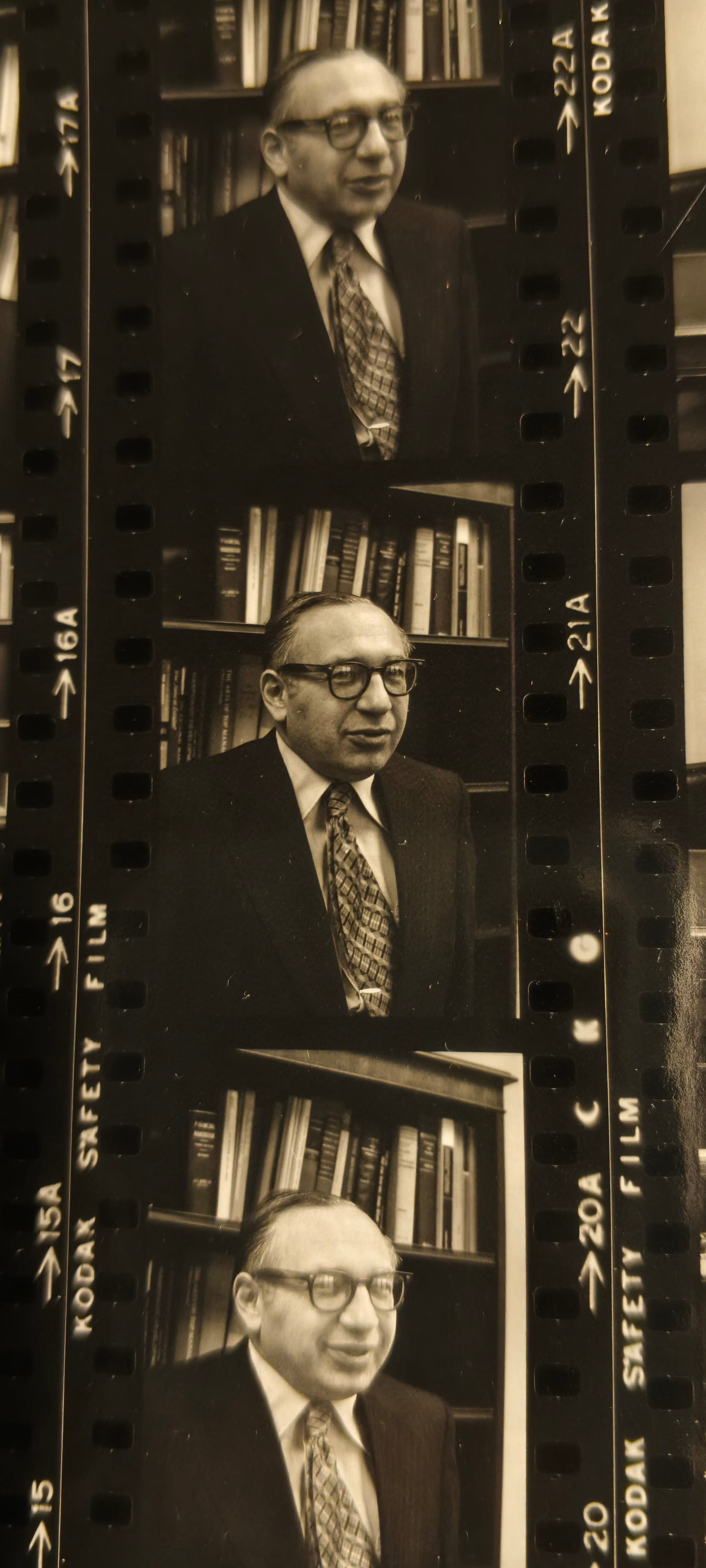
Enter Herbert Terry–my father. He was a chemical engineer specializing in industrial coatings and cleaning products. His patent titled Coating Compositions was filed in 1951 with his colleague Dan Schoenholz, and their formula for a new type of paper coating became the prototype for what is now the industry standard.
“This invention relates to paperfinishing compositions and more particularly to emulsion compositions containing as a main film forming constituent polyvinyl acetate.
It is usual to provide paper book covers, playing cards and other printed paper articles which are subjected to considerable handling, with a glossy coating designed to improve their appearance and wear-resistance. So far, the applicants know of no polyvinyl acetate emulsion which has been successfully used for this purpose.”
–from the Introduction of Patent 2,536,018 by Daniel Schoenholz and Herbert Terry, granted Jan. 2, 1951
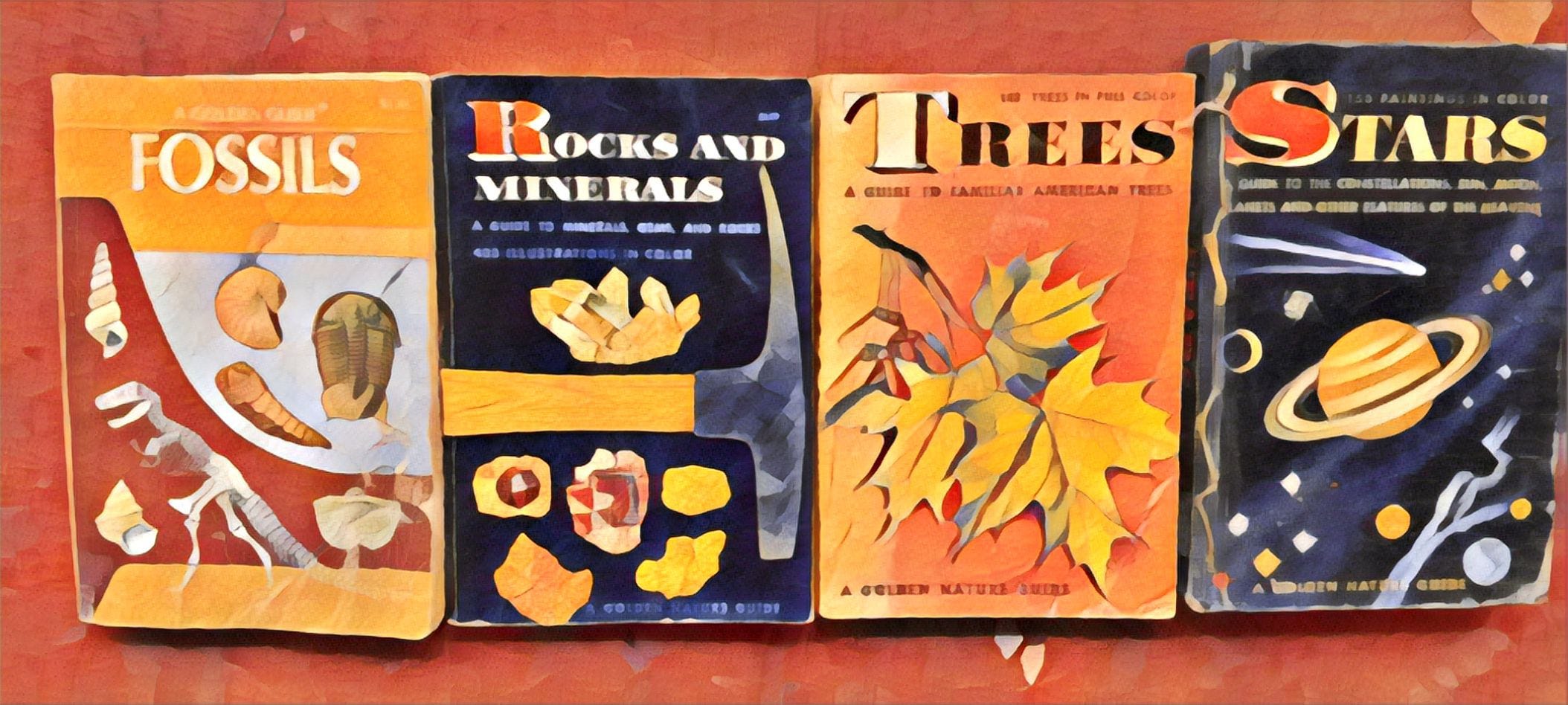
Because my dad was a chemical engineer, when I was a kid my toys were a chemistry set, a microscope, a geology kit, a set of magnets, a ViewMaster with science discs, a Spirograph, and various Golden Nature Guide books. I had never seen a board game, until one day I had a birthday party and all the kids brought them as presents. Perhaps it was then that I first realized there was a whole world out there full of normal people, and I wasn’t one of them.
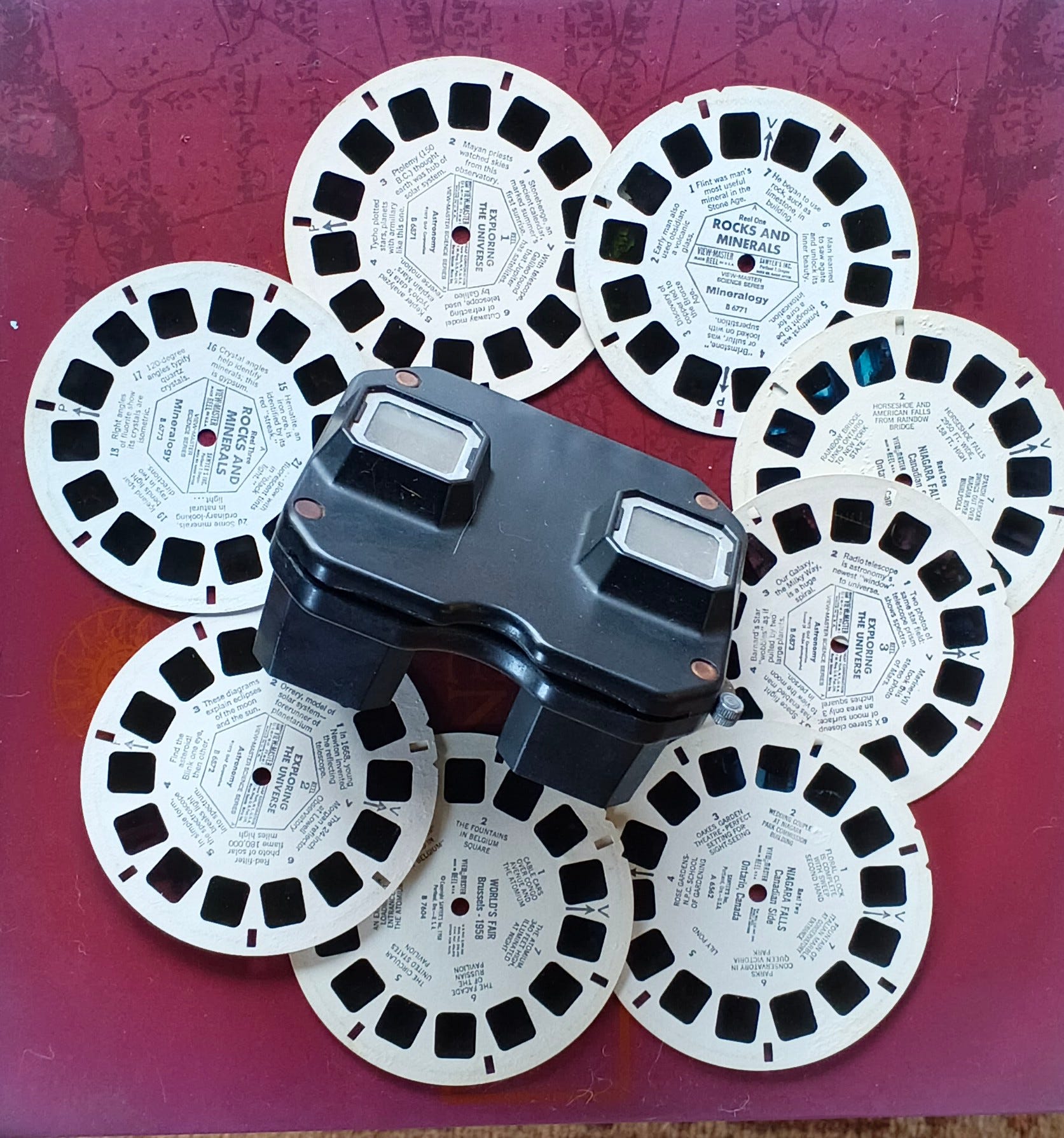
Part of the author’s [now antique] ViewMaster collection
My dad told me that when a coating was invented for cans of pineapple chunks, people complained that the pineapple no longer had that nice metallic taste they were used to.
He showed me how you could run a comb through your hair, then hold it next to water coming out of the tap and it would bend the water stream with static electricity.
When I was given an edition of Alice in Wonderland, he told me that the character of the Mad Hatter was based on real life, because hatters used to work with mercury to make the felt for hats, and the mercury vapors caused a number of neurological symptoms.
He said that when companies make new products, often they just duplicate their competitor’s product and add an inert ingredient or two in order to be able to make a new patent!
GLOSSARY
• Polyvinyl acetate–Commonly known as “wood glue,” “carpenter’s glue” or “Elmer’s Glue.”
• Polymer–a large molecule made up of many repeating smaller units called monomers. Polymers can be natural, like proteins and DNA, or synthetic, like plastics and rubber.
• Solvent–a substance that dissolves a solute, resulting in a solution. It is usually a liquid, like water, but can also be a solid, gas, or supercritical fluid.
• Celluloid–the first synthetic plastic, created by mixing nitrocellulose and camphor, which makes it tough, flexible, and moldable. It was widely used in the 19th and early 20th centuries for items like photographic film, combs, and musical instruments, but has since been largely replaced by more modern materials.
• Emulsion–a mixture of two or more liquids that normally do not mix, such as oil and water.
• Nitric acid–a colorless, highly corrosive liquid with the chemical formula HNO₃, commonly used in the production of fertilizers, explosives, and dyes.
• Sulfuric acid–a strong mineral acid with the chemical formula H₂SO₄. It is a colorless, odorless, and viscous liquid that is highly corrosive and commonly used in various industrial processes, including fertilizer production and chemical manufacturing.
My father’s low-hazard, water-based coating method replaced older solvent lacquer systems that were flammable, and harder to process. And that’s another thing my dad told me: the word ‘flammable’ was originally ‘inflammable,’ as it appears in Spanish for instance. But the public thought that ‘inflammable’ meant ‘non-flammable,’ so that was a linguistic dealbreaker.
Playing cards are engineered to resist oils, moisture and abrasion, and my father was one of the pioneers of early generations of these protective films. But the chemistry of durability is not the same as the chemistry of detonation. William Kolgut’s death resulted not from nitrate combustion, but from the oldest industrial power known to Mankind: steam.
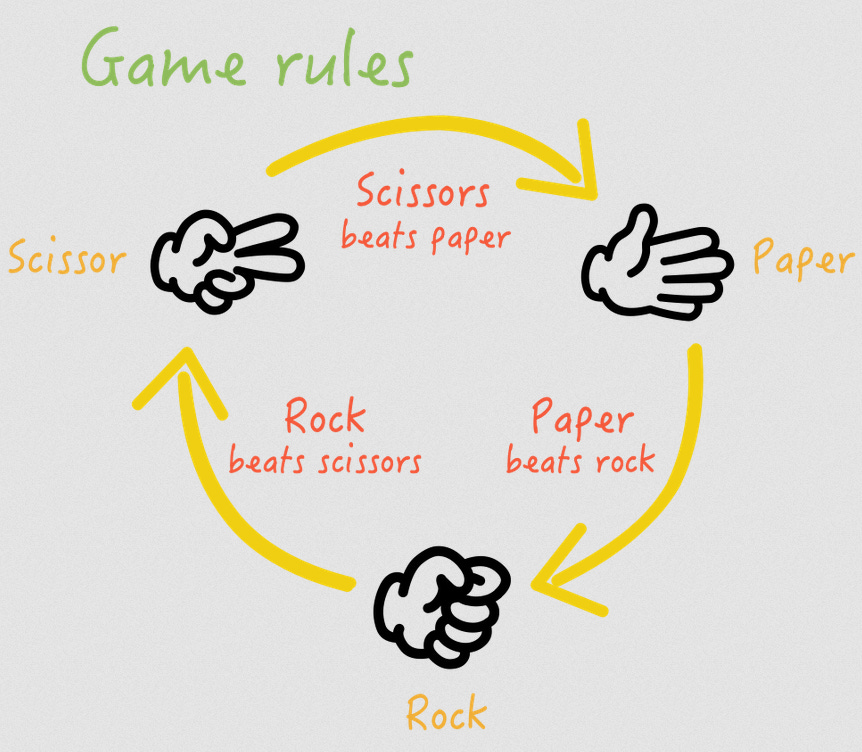
If we were playing Rock-Paper-Scissors, we might add Steam for a little more realism, and excitement:
Steam coats Rock
Steam bends Scissors
Steam propels Paper
Dad wasn’t a household name. He didn’t discover a new element or invent CRISPR gene editing. His work was far less dramatic, but far more applicable to daily life. It sits at the transition point when solvent lacquers were replaced by water-based polymer coatings. His work was the beginning of the finishes that are now applied to everything from paperback book covers to packaging materials to playing cards. The inventors’ addition of wax was a unique feature that became standard practice in mid-20th century paper coating.
So the next time you bring a paperback to the beach, you can thank my dad.
When I was young, things were inflammable and we were under strict orders not to apply lighted matches to such things. The destruction of the English language to make things simple for Americans is one of the great tragedies of our age. Among other problems, it has lead to our current political situation where language is incinerated to produce power.
Who says you can't teach an old dog new tricks? I've learned two new things today and I've not yet had lunch. One -- the next time I'm in prison I'm gonna make that card coating pipe bomb thing, but instead of putting it to my head, put it up against my butt so the explosion will blast me out of prison into low orbit. Where I come down will be part of the adventure. And Two -- I want your dad to be my dad. Viva Herb!