
3 Essential Skills
Necessary for performers, but applicable to anyone in any field

A colleague apologized to me for screwing up one of the tunes on the gig. “I lost my concentration,” he said.
I told him, “preparation is more important than concentration.”
Why?
Because preparation is within your control. Concentration is not. It’s subject to whatever distractions may occur in a live performance. Yes, it can be trained, but concentration is just not a good substitute for preparation. Good preparation is something you can rely on.
Harry Houdini was able to pull off all those unbelievable feats–escaping from handcuffs while completely submerged in a water tank, etc.–because of his obsession with preparation.
We practice not to make our highest level higher, but to make our lowest level higher. That way, even if you feel like you sucked, you were still really good.
One of my readers argued that Houdini had both preparation and concentration. Sure, you can have both, and one should have both. Preparation is the precursor of Concentration, and vice versa. Many people, however, (like my colleague) aren’t able to start with Concentration. But he can force himself to prepare. Then, through preparing, a state of concentration can be arrived at.
Let’s delve further. What is the real difference between a performing artist as opposed to one who normally does not perform, like a writer or a painter? There is a certain mindset one needs to be a performer. It involves, basically, three states:
• PREPARATION
• CONCENTRATION
• INTENT
Each of these states has a different feeling. Each one has a different function, and is applied to different situations. A performing artist is constantly under pressure to perform at a high level, and does not have the luxuries of time, privacy or a controlled environment when on stage. Therefore, these states, which are actually skills, must be cultivated off stage so they can be achieved on stage.
There is also a fourth state:
• RELAXATION
In this state, all the previous three states are included and are effortless. But you cannot achieve the state of relaxation on command until you have slogged through and mastered the first three. Performers instinctively know that they perform better if they’re relaxed. But too often they try the shortcut of using drugs or alcohol to cut right to relaxation, rather than cultivating it through the difficult process of mastering Preparation, Concentration, and Intent.
Performing is very psychological. Whether you can verbally articulate or mentally pinpoint these states matters not...but the states must be known by their feeling, because they each produce different results.
Furthermore, if the state of relaxation cannot be achieved while performing, mastery of the first three states will get you through it regardless. But the relaxation is the fun of it. When you get there, you’re not working anymore, you’re playing. As the Tao Te Ching says, “The Tao of the sage is work without effort.”
Let’s break down the states one by one.
PREPARATION
It may seem obvious...a performer practices, behind the scenes, before presenting to the public. But we can divide even further into long-term and short-term preparation. Long-term preparation is a lifelong process. It means you show up every day and you work on stuff in a methodical manner. Exercises you develop during your practice time can be utilized and modified for years afterward, as your ability increases and also changes with age.
Short-term preparation is your warm-up. Most people think the warm up is for the body. It is not. It is for the instrument.
In some cases, the body and the instrument are the same: in singing, or in dance, for instance.
But for players of musical instruments, the warm-up ritual is for the musical instrument. Here’s why: When we first pick up the instrument after not having played it since the day before, it is literally cold. The material of which it’s composed–whether wood, metal, plastic, resin, hard rubber or something else–is made up of molecules that need to be set into vibration mode.
We do that by playing the instrument. If it’s a wind instrument like a clarinet or a trumpet, passing your breath through the instrument sets the molecules into vibration mode and that excitation warms up the instrument. If it’s a string or percussion instrument, the idea is similar, because as you engage the strings or strike the drum head or piano keyboard, the material vibrates and the instrument warms up.
Instruments will often carry over their vibratory state into the next day, so that when you pick it up after not playing it for several hours it still responds well, and it takes less time to warm up fully.
There are even stories about legendary masters who died, and when their disciple is bequeathed the master’s instrument and begins to play it, their tone sounds just like the master, for a minute, until the vibratory field imbued by the master’s years of playing it dissipates.
CONCENTRATION
Concentration cultivated over years means you can apply it on the fly. But as noted previously, it cannot be relied upon unless one has done the Preparation. There are just too many unpredictable variables in a performance situation to be able to rely on Concentration as your go-to strategy.
In order to apply Concentration most effectively, it must be melded with Intent. The conditions present when you need to apply Concentration on the spot (noise, stress, other distractions) will stop Concentration unless Intent is combined with it.
INTENT
This is an interesting concept. I often think of it in Castaneda-like terms.
“Intent is not a thought, or an object, or a wish. Intent is what can make a man succeed when his thoughts tell him that he is defeated. It operates in spite of the warrior’s indulgence. Intent is what makes him invulnerable. Intent is what sends a shaman through a wall, through space, to infinity.” - Don Juan, via Carlos Castaneda
In jazz, while we’re playing and we have a section of the music approaching that is difficult–be it an entrance, a complicated fingering, a certain articulation that must be used, or other challenge–we say you have to “lay for it.” Like a tiger waiting for the right moment to pounce.
Intent is used a lot in Wushu, Chinese martial arts. Their word is “yi,” frequently translated as “mind” but referring to a quality of mind that is able to touch the target, energetically speaking.
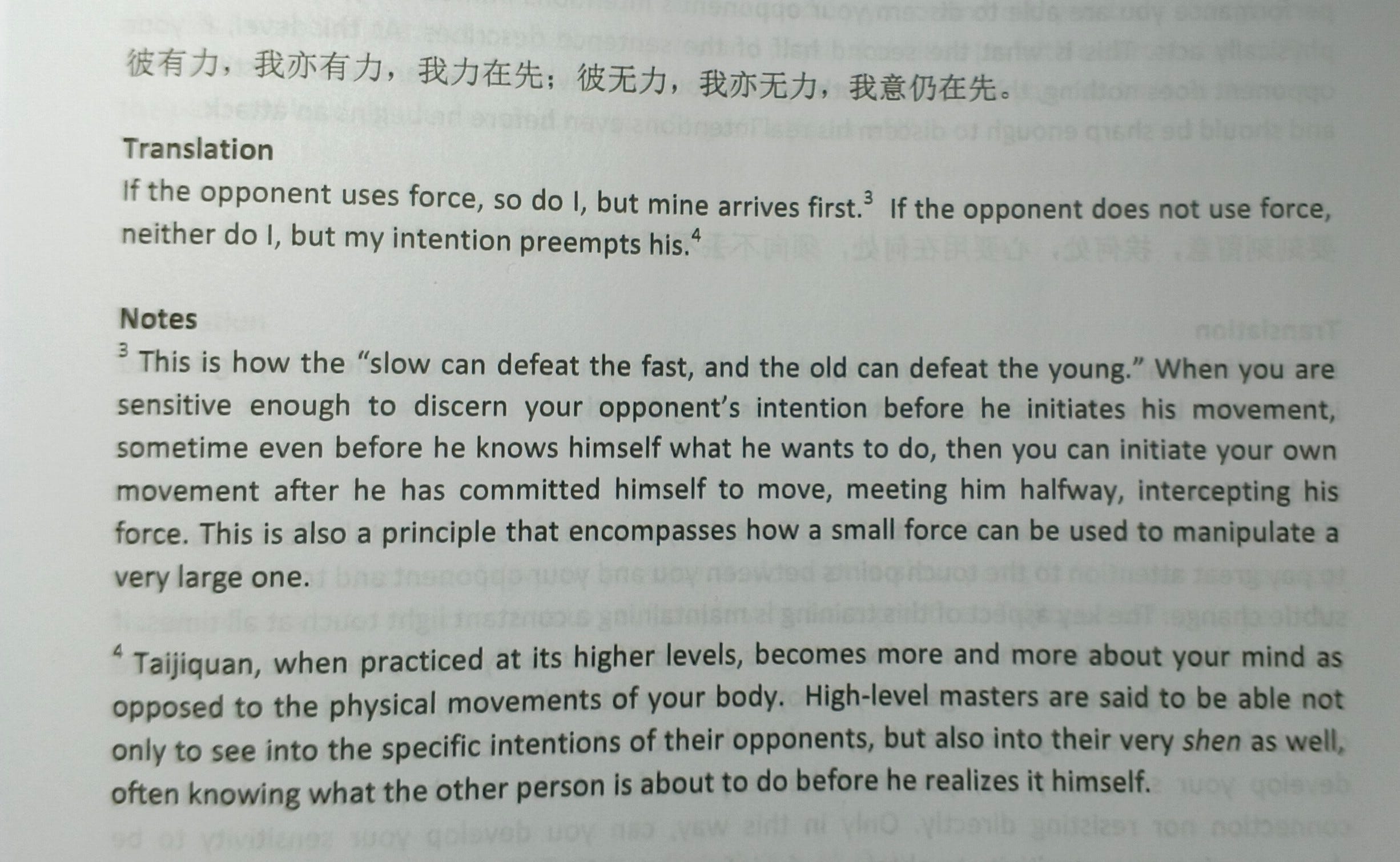
From page 223 of The Taijiquan Classics by Zhang Yun, Ho, Capell, Darley. Published by Yin Cheng Gong Fa Association, 2016
The fourth skill, coveted by all but not always achieved, is:
RELAXATION
Stan Getz reputedly said, when asked what he thought about while onstage, “I’m just trying to relax.”
Sometimes you can luck into a relaxed state. But again, a professional performer does not rely on luck. We train and train and train in order to be able to attain the state of relaxation.
Are there external aids that can be used? Of course. As we alluded to earlier, various drugs have been used for this purpose by performers since the beginning of time, and still are. The problem with most drugs is that they impair both perception and motor coordination when the dosage is not precise. They can also have undesireable after effects. So these are not things we want to rely on when it comes to being relaxed.
My old friend Janice Friedman, a marvelous pianist, told me years ago that she always does a short self-hypnosis session just prior to a performance.
Another friend, the late pianist Hal Galper, wrote extensively about the state of Relaxation, which he calls The Zone.
“Have you ever had the feeling the musical decisions you’re making were out of your hands, as if someone else were making them or coming from a mystical, or mythical ‘somewhere else’? That’s what it feels like when you’re in the zone.” –Hal Galper
Some performers who are more prone to anxiety may need additional help. I am not a doctor and this is not medical advice, but I personally take GABA before a performance and find it really helps. I even carry capsules in my horn case. GABA is a neurotransmitter found naturally in the central nervous system (but there’s just not enough of it) and it calms the anxiety without detracting from motor coordination or perceptive awareness.
If you’re going to try it, you may have to experiment with brands, because each one has a different additive that they combine with the GABA. I use a brand called Zen Mind.
Of course, true relaxation is something which permeates the physical, the mental, and the spirit. Therefore, it’s essential for a performer to engage in some sort of physical activity during which relaxation can be practiced. Because to relax does not mean to go limp. It simply means that one is not holding tension in any part of the body–not only the hands, arms, shoulders, legs, feet or back, but also the neck, the waist, the jaw, and other areas where we don’t think about tension.
When tension is gone but the body retains its structure, the energy can flow through the body unimpeded. We can think of this like a hose: if a hose kinks, the flow of water stops. The hose must be “relaxed” and open–but not collapsed– in order that the water (energy) can flow through it.
Physical work is needed so that one becomes accustomed to how energy flows in the body. Recommended practices for this are Tai Chi, Qigong, Yoga, Pilates, Alexander Technique, etc.
When Preparation, Concentration, Intent and Relaxation are combined, you will be unstoppable. But don’t look for shortcuts, like the guy in Limitless. Do the work, and you’ll have these skills forever.
The Zone, The Groove, Taksu, Rasa: many words decribing the same feeling. the more one prepares, the more one can let go at the precise, right moment, reaching that outwordly level. great post, TQ
I can vouch for Zen Mind for sleep also. I also use GABA from Now, which is much cheaper.
Very interesting article, Su. Didn’t put me to sleep at all.