
What is Improvisation?
And why are we so afraid of it?

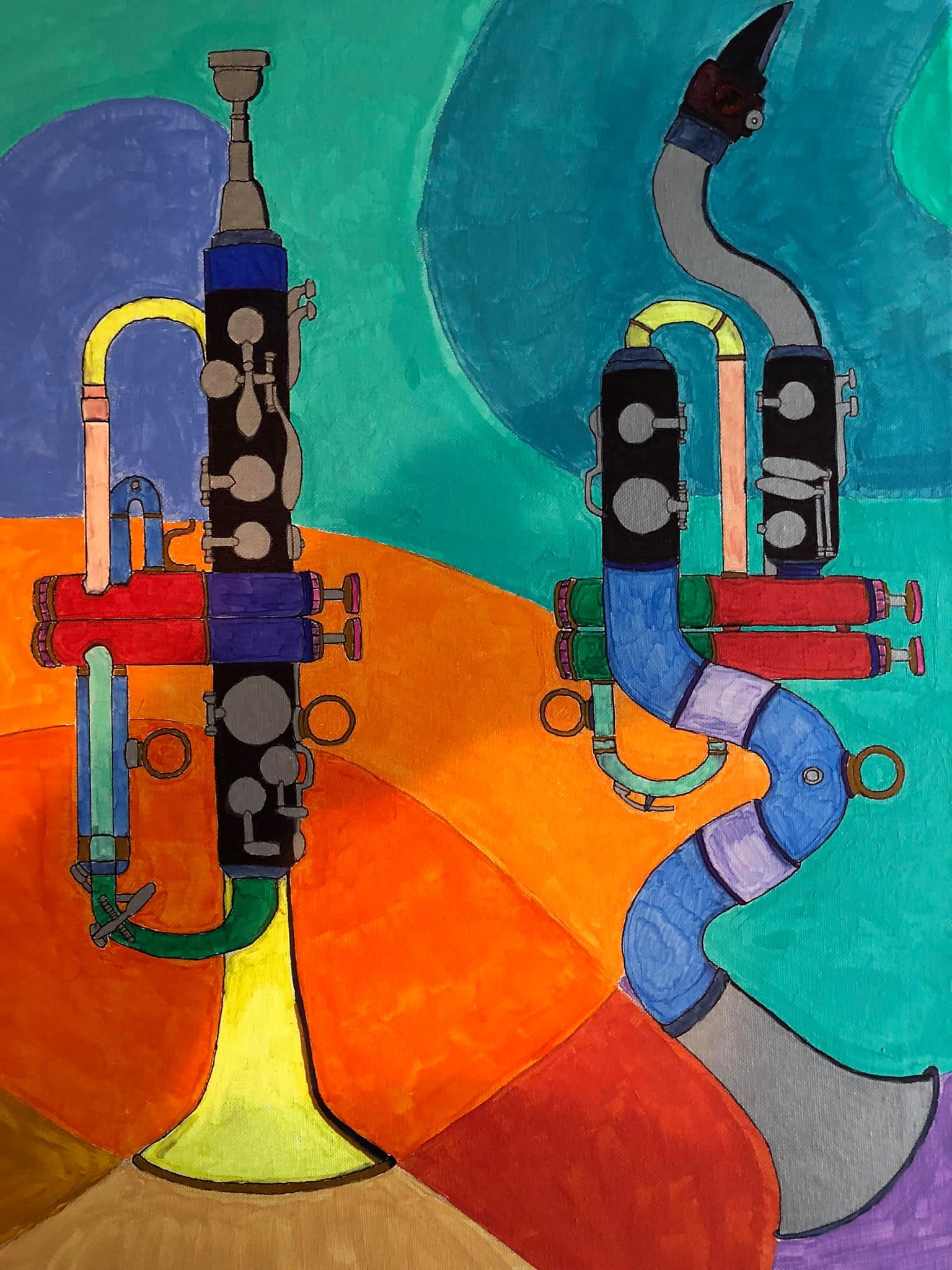
Bass-Trumpinet and Bass Clarumpet 16x20 Acrylic. Painting by musician/composer/painter Matt Lavelle.
The first thing I would want to say about improvisation is that we ought to think about the word "improvisation” because it implies something casual, offhand, without preparation.
What we are actually doing, when we're soloing, is something completely different. We are composing. So a lot of us improvisers prefer the term spontaneous composition.
In order to solo effectively on a tune we have to know everything we can about the tune, including the original melody, the harmony, the rhythmic phrases. If you ask the masters, they will tell you it's essential to know the lyrics when playing a ballad. Not only for the melody but also the improv, because you're not only improvising on the tune, you're improvising on the IDEA of the tune.
Let's take the song "Alone Together" by Arthur Schwartz and Howard Dietz. The form is unusual: 14-14-8-8. One could say that the extended structure symbolizes the idea that two people in love feel separated from the rest of the world. They feel alone together. The lyrics to the tune, then, are not the sole indicators of the mood of the song, but are aided and abetted by the song structure. Contemplating this can help you create your solo.
An additional idea that I like to consider (although it is not indicated in the lyric, because that wouldn’t be so romantic!) is that when you and your partner are having a tiff, and you’re sitting there together, you’re each in your separate thoughts–alone together.
Where did this concept come from, superimposing your own ideas on someone else's song?
When we think of it as spontaneous composition, the answer is clear: it's a natural outgrowth of human creativity. We see it in classical music as "theme and variations" or in improvised cadenzas. We hear singers embellish the melody, stretch it out or truncate it, add their own lyrics. We enjoy arrangements of familiar tunes played in another style. So we don't need to think of improv as something separate, it's very much part of musical tradition. What we do in jazz is emphasize the improv section. Remember, it's all composition, whether spontaneous or written.
The first improvisers lived in caves or primitive villages. Their spontaneous compositions echoed the sounds of the birds, the wind, the rain, even the sound of Death. As musicianship advances through the centuries, players and composers still return to the sounds of Nature to express the range of human feeling.
Improvisation is not restricted to the jazz genre. The legendary jazz saxophonist Steve Lacy named the shakuhachi master Watazumi as one of the great improvisers of the world. Lacy made tours to Japan just so he could study with Watazumi.
The troubadours of medieval Europe are thought of as wandering minstrels who spontaneously composed verses and songs for romantic purposes. But most of them were dedicated to a higher calling. They considered love to be a power from God that could elevate humans from the prevailing religion that emphasized sorrow and pain. They were also the only ones who could step out of their roles as entertainers at court, and as Manly Palmer Hall describes, they could "contradict the King, ridicule the nobles, and attack the policies of their time. Like the court jester they were immune from all punishment, and might behave as they pleased." (Manly Palmer Hall, Pathways to Philosophy)
This story demonstrates an application of improvisation-spontaneous composition to life itself. As the old saying goes, "Life is what happens when you're busy making other plans." Someone who is skilled in the art of musical improvisation can apply the skills of listening, understanding patterns and relationships, knowing when to take the lead and when to pull back, knowing their role in any given situation, feeling when it's necessary to conserve energy or expend it, and many other lessons, when dealing with life situations.
Saxophonist Luis Siguenza, from Quito, was visiting my area and requested a lesson. I asked him what he wanted to work on. He said, “whatever you want to show me….about music….about life.” My kind of student!
The good news about studying improvisation is that now there are so many materials available: recordings in audio and video, YouTube, professors at schools, online learning, downloadable transcriptions, etc. The bad news is, everyone else is using those same materials. So what are you going to bring to the table?
Don't think of yourself as a musician. Think of yourself as an artist. That way you utilize all aspects of what makes great art, of any genre. We should understand concepts like the Golden Ratio (aka "Golden Proportion"), and other design principles such as color, texture, proportion, intensity, dynamics, repetition, motifs, space, phrasing, tempo, tone, and the ultimate skill: LISTENING.
These skills may have different names when applied to literature, dance, visual art, poetry–even martial arts! But the concepts are the same.
Once I saw a video about an archery master. He wanted to understand the way archery was used in ancient times for battle, not just for sport. So he studied old paintings of archers in detail, to learn whatever secrets he could. Through his studies he found ways to cultivate skills that no one else in sport archery could do. This is called going to the source.
Remember that improvisation is about freedom. Yet it's also about structure. Because as the filmmaker Federico Fellini said, "for an artist, it is essential to have restrictions, limitations to struggle against. For a creative personality, unlimited options are dangerous. You have to come up against something ineluctable, a reality principle that gives a shape to the endless creations of your fantasy."
While we use given structures to improvise upon, our job is to find freedom through those structures. The purpose of the structures is to have something to play with. There’s no need to feel imprisoned by them. Don't let anyone keep you in a box, and don't keep yourself in a box. Take scales, for instance. Never think of them as scales: they are note sets. Free the notes from their sequence so they can be used in any order you want. That's freedom through structure.
We study the standards of the Great American Songbook because they are impeccable structures. They are amazing and complete works of art. But we are improvisers, and we're never satisfied with leaving them the way they are, or playing them the same way every time. That said, we are also looking to go deep inside the compositions. We can do that in many ways. The first way is to play the melody. Play it with profound expression, thoughtful phrasing, and beauty of tone.
Moreover, as spontaneous composers, we have to separate the melody… from the harmony… from the rhythm. Each of these components is raw material for spontaneous composition. So take a tune and dissect its melodic, harmonic and rhythmic structure. It's like, if you want to build a clock, first you take a clock apart so you can see how it works.
We could speak about the art of spontaneous composition for days, but the best way to explore it is to do it. The path of music is infinite, and it goes in all directions. Find your personal path within that infinity. It will serve you well, and you'll have something that can never be taken from you.
Dear Su, you remind me today of a piece of musical wisdom from the great Quincy Jones, who said the first thing he does when composing something new is assign self-imposed parameters. Ex. "I'm going to write something with 217 bars in the key of A Major. It will be in 3/4 jazz time at quarter note equals 188." By giving shape to the limitless possibilities he is then free to change his mind about any aspect of the initial intention as it arises - to decide that in fact, it is better in another key, another time signature, a different tempo. The piece dictates what it wants to become, revealing itself from a vastly different starting point. This is not only okay; it is desirable, and part of the process. Also, I'd encourage new composers and improvising musicians to learn the parallels between Bach figured-bass and lead sheet changes. Two sides of the same coin. Lastly, Happy Father's Day, men and ladies, alike! In a perfect world the masculine and feminine energies also become roles independent, yet reliant, upon each other.
My first experience with improvisation was in the 7th. grade. One day, after school, Joe Mericle, ( now there's a name for you) and I met in the band room. Joe played tenor sax and it was my first experience behind a drum set. We both we fans of Big Jay McNeely and Joe Houston, a couple of honkers and shouters in the R&B world, and we began to play in that style. We played as fast as we could and at some point, that thing happened when the music entered another realm and we were being played. Mr. Piper, the band director left us to our own devices and never interfered. I can't imagine what that cacophony sounded like to him. It was years before I entered that realm again.