
So Fa, So Good
The Battle of Fixed Do VS Moveable Do

I was 14 years old, and my dad was taking me to a party in New York City!
We lived an hour north of the city but I often went there with my parents, as my father was a native New Yorker. (After a brief time in Massachusetts, where he married my mother, they tried to move back to New York. But they ended up in Connecticut after circling the Big Apple trying to park.)
In his youth my dad had been a caller (the one who calls out the moves for the dancers) for the American Square Dance Group, and he knew many musicians, including banjoists Stu Jamieson, Pete Seeger, and the folklorist (and founder of the ASDG) Margot Mayo.
I was excited at the prospect of going to a musician’s party since I was the best clarinetist in my junior high school. As promised, lots of music people were there singing and playing (including a bagpiper)! At a certain point they started passing out little books of four-part choral pieces. “Do you sight-sing?” asked a lady, handing me one of the books. “Sure,” I replied. Hey, if it had anything to do with music, I was on it like white on rice!
Someone gave a count off and everyone started singing. I tried to sing my alto part, but I couldn’t figure out how everyone knew what the notes sounded like with no instruments playing. I could sight-read playing my clarinet, but this sight-SINGING thing mystified me. I realized there was something big missing from my musical toolbox.
I was a musician, which would indicate that I should know what the notes sounded like when I looked at them on paper. But I didn’t. Because no one had ever taught me how to do that, and at 14 years old, I hadn’t figured it out yet. The insecurity planted itself in my mind, and it was still there four years later when I entered the Hartt School of Music in the late 1970s. As a freshman I had to take the required ear training courses, but I found they weren’t really helping me. They weren’t helping me because there was no system, no structure. It was like so many other things one comes across in one’s formal schooling: memorize this, memorize that. No foundation. No roots.
I soon discovered there were secret ear training courses at Hartt. These courses weren’t publicized. No one talked about them; maybe because they were considered sort of “fringe” courses, taught by visiting faculty from Hungary who came to Hartford every year to teach. I found out that I could take one of their immersion courses over the summer. It was promoted not as an ear training course, but as a pedagogy course for those on track to teach school music programs. I was not a music ed major, but somehow I intuited that they had a system that would help my ear training.
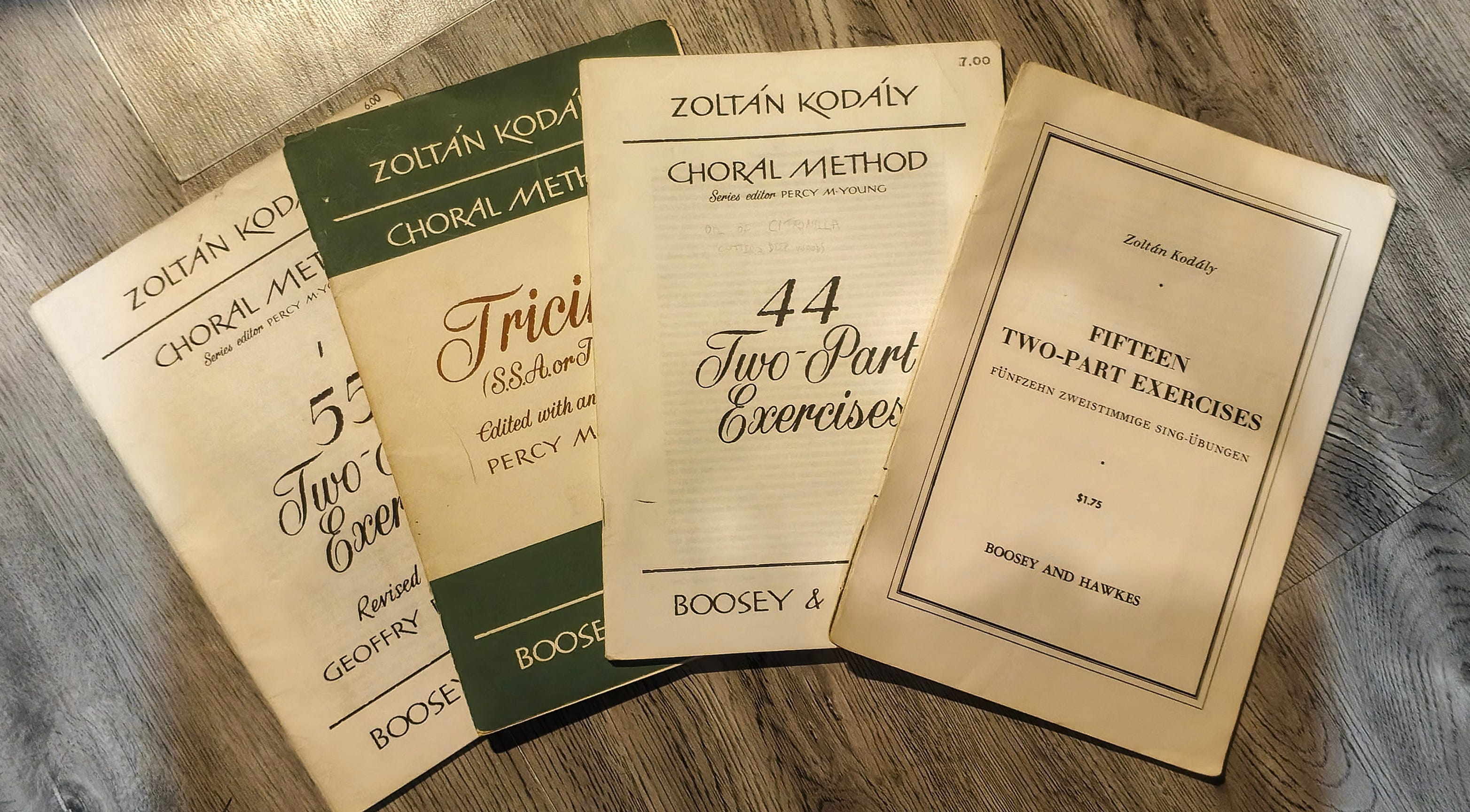
The Hungarian teachers were amazing musicians! They would hear a random pop song on the radio and start singing it in solfege (aka ‘solfa’ or ‘solfeggio’). They had been trained at the Liszt Academy, one of the premier music academies in the world. They taught the Kodaly System, named for Hungarian composer Zoltan Kodaly [“Ko-dai”], a contemporary of Bela Bartok.
Both Kodaly and Bartok believed that the folk melodies of every country were foundational both for teaching music to its children, and as basic repertoire on which more contemporary music could be built.
At the Kodaly Musical Training Institute (now simply called the Kodaly Music Institute) summer program, I found the missing piece. It was through learning the moveable do [‘do’ is pronounced ‘doe’, as in ‘doe, a deer’] solfege system. This system has little in common with the fixed do solfege system, which was what was taught in the ear training classes I had been taking.
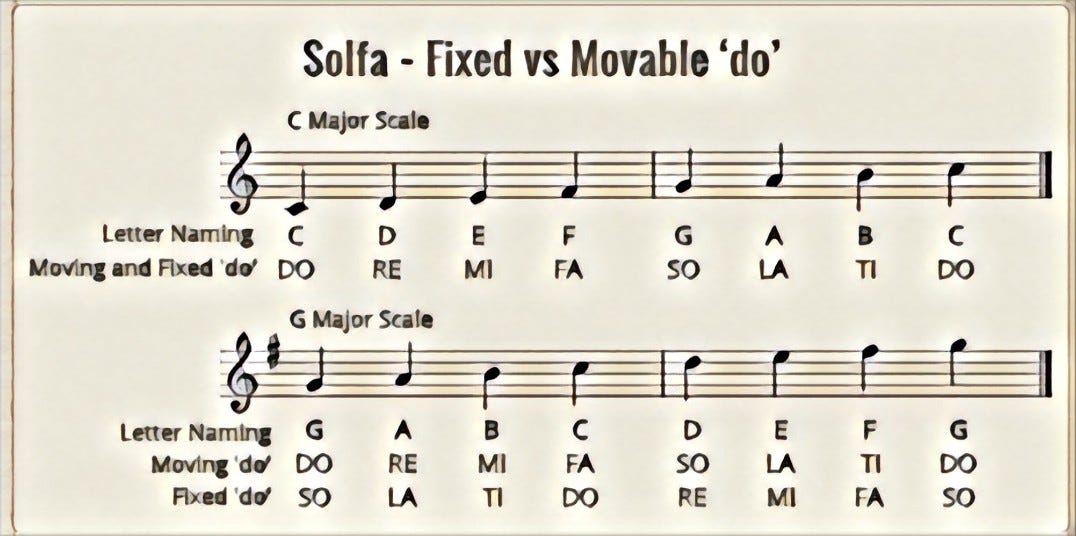
Seems like we’ve been arguing about which system is better ever since ol’ Guido d’Arezzo, in the 11th century, took the Latin hymn Ut Queant Laxis and used the beginning syllable of each line to represent notes in the diatonic (major) scale. Both systems are based on the idea of substituting syllables such as do, re, mi for note names like C, D, E. The difference is that in fixed do the syllables correspond to pitch NAMES, and in moveable do they correspond to pitch POSITIONS, or functions, in the scale.
Oh yes, notes have functions! Just as chords do. A perfect 4th, for instance, wants to resolve to its lower neighbor, the major 3rd…the major 7th (referred to as the “leading tone”) wants to lead us back to its upper neighbor, the do (the tonic of the key we’re in)…the 3rd indicates whether we’re in a major or minor tonality…etc. There are 12 tones in an octave, according to the tuning system we use in the West (Equal Temperament), and each one has its own function.
(Please note that Equal Temperament is a convenient, but artificial tuning system. It’s not found in Nature. It is a can of worms that we won’t go into right now. We’ve got our hands full just juggling these 12 bouncing balls.)
To summarize: each of these chromatic tones (“chromatic”= sound color...another can of worms) has a function. That function is dependent upon its position in the scale, and also its relationship to the other notes, with their own respective functions.
I tell my students the notes are like family members. Let’s imagine the note A is a guy named Adam. Adam is Eve’s husband. He’s Jane’s father. He’s Frank’s brother, and he’s Mary’s son. Adam has other functions too. At work he’s the Manager. On his community baseball team he’s the shortstop. At the coffee shop he’s that guy who always buys a gluten-free muffin.
Same person, different functions according to the context.
Unlike in the United States, many other countries refer to notes not by letter names but by their assigned names in the fixed do solfege system, which uses the note C as its base. There are variations of fixed do methods: some do not recognize sharps and flats in the syllable, for instance. In that case, the notes G, Gb and G# would all use the syllable “so” (or “sol”) even though they sound different when sung. Other fixed do methods apply syllables to the chromatic tones as well: C# is “di”, Bb is “ta”, etc.
The moveable do system will work the same as the fixed do system in one instance only: if the tonic is C. The special feature of moveable do is that it preserves the relationships of the intervals (distances between notes) by always calling the tonic “do” no matter what key you’re in. Thus, if you want to sing a major triad up from root position, you’ll always sing do-mi-so (minor third interval stacked on top of major third interval). Whereas in fixed do, an F triad would be called “fa-la-do”, a G triad would be “so-ti-re”, and so forth.
The problem with fixed do is that the relationships of the intervals are not preserved. Whereas in moveable do, once you ascertain what key the music is written in, you now have the key to decipher how the notes sound when played or sung. The distance between do and mi is ALWAYS a major 3rd. The distance between mi and so is ALWAYS a minor 3rd. And so forth. It also makes it very easy to transpose the song to any other key, because you understand the intervals that make up the melody.
One thing to be aware of–which may be confusing–is that we use the same terminology for scale position of a note as we do for intervals.
Ascending from the Tonic, we have:
Minor 2nd
Major 2nd
Minor 3rd
Major 3rd
Perfect 4th
Diminished 5th
Perfect 5th
Augmented 5th
Major 6th
Minor 7th
Major 7th
Octave
N.B. These positions have additional names, depending on how they are ‘spelled.’ In Equal Temperament, an F# sounds the same as a Gb, a G# sounds the same as an Ab, an A natural sounds the same as a B double flat, etc. All notes can have three different names depending on their context. (Eve calls Adam “honey.” Jane calls him “Dad.” Frank calls him “Bro.” Mary calls him “Son.” At work he’s “Mr. Jones.” The team calls him “Shorty.” The coffee shop cashier calls him “Mr. GF.”)
It’s kind of like the Heisenberg Principle of music, except that in music we can know the position and the distance of notes simultaneously! To illustrate: the position so–the fifth note of the major scale–is called the perfect 5th of the key. But the distance from do to so is also called a perfect 5th. Likewise with the distance between la and upper mi, or re and la, or mi and ti. We use those terms for two different things, position and distance.
Now let’s get back to solfege.
Example: Let’s say you have a song, something easy...how about Twinkle Twinkle Little Star. I think everyone here knows that this theme comes from a Mozart solo piano composition composed in the later 18th century. The melody is also used in the nursery tunes Baa Baa Black Sheep and the Alphabet Song.
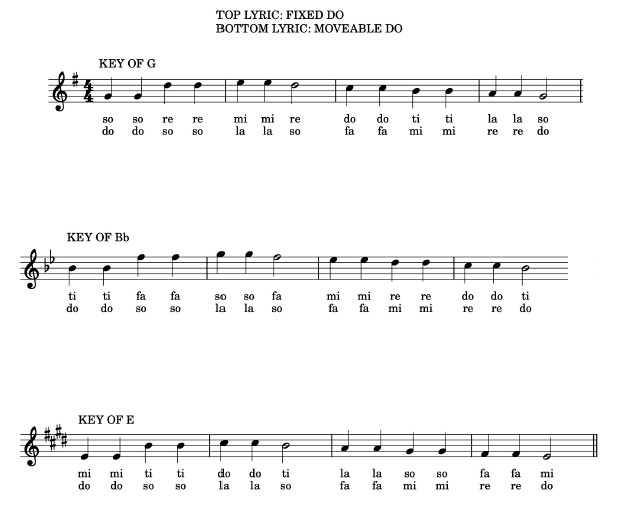
If you were using fixed do to sing the tune in these different keys, you would be singing three different solfege sets. But in moveable do, one can easily see that this is the exact same melody, just represented in different keys. You use the same solfege set for all three examples.
By the way, for those who have come across these New Age videos purporting to reveal the secrets of the Universe through so-called “solfeggio tones,” please know that this is complete bullshit. “Solfeggio tones” is just a marketing ploy. If you want to listen to sacred music that truly can change your state of mind, emotions and spirit, just go listen to Hildegard von Bingen, or Gregorian chant, or Miles Davis, or Arvo Pärt, or Bach, or Beethoven, or Erik Satie, or Lili Boulanger, or a Baptist choir, or shakuhachi Honkyoku, or ...
When conservatory-trained musicians are asked to recall their musical education, they will almost certainly declare which system of solfege they learned: fixed do, or moveable do. Not only will they make mention of this fact, they will usually affirm the superiority of the system they were trained in while simultaneously trashing the “opposing” system. Indeed, musicians’ torch-carrying zealotry for their preferred solfege method rivals that of the Hatfields and the McCoys, only without the shotguns. (We do have axes, however.)
Truly advanced musicianship requires skill in both pitch recognition AND pitch function. We exercise our command of the music not only by producing beautiful individual tones but also in the way we shape the intervals. Like a basketball player swishing a free throw into the net, we must have a spatial sense of an interval before we can play or sing it accurately. (This challenge becomes even more complex when we play with different ensembles. The Equal Temperament required to blend with a piano, for instance, veers quite naturally in the direction of the more natural Just Intonation system as soon as pitch-flexible instruments like winds, strings or voices have no equal-tempered instrument to contend with.)
This short video, in addition to giving a comparison between ET and JI, also lets you understand why early classical pieces had names like “Sonata in F” or “Concerto in Bb”–it’s because they literally could not be played in any other key, or they would sound bad.
I suppose that someone with perfect pitch (the ability to name any note sounded, without a context) might be bothered by moveable do. But my research shows that one’s perfect pitch can alter with age. Furthermore, even though A=440 is supposedly the current standard, in European orchestras they tune higher, and before Bach many standards existed simultaneously, most having an A that was under 440 cycles per second.
That said, many professional musicians develop the ability to recognize tone colors even if they didn’t have perfect pitch growing up. But they’re not as good as Dylan Beato:
Rick Beato’s kid has become famous via these perfect pitch demonstrations on YouTube.
“In my own personal research, I have come to the conclusion that it is not an “all or nothing” ability. Certainly Pavarotti, with his ability to discern between “A 440” and “A 438”, had an incredible ear. But the common person who hears a television theme song, and then hums the melody while doing dishes, and consistently does it in the same key, is blessed with perfect pitch too. I can play basketball enough to enjoy shooting hoops on occasion, but the NBA would never have me, and rightfully so. Perfect pitch is likewise an ability that all can work on, if desired, but the fact that very few professional musicians have that highly developed ability is a testament to the fact that it is not necessary. Nor does having perfect pitch guarantee a musician success in their field.” - Source
Folk songs, pop tunes, and pieces from the classical tradition or the Great American Songbook are well-served by moveable do, the challenge being recognizing modulations so that one can re-locate the “do” for a new key within the song, such as the bridge. And regarding music pedagogy, some educators feel moveable do is the most effective for beginners. Conversely, much 20th and 21st century repertoire, which is not as focused on clear tonal centers, is often better approached with fixed do.
That said, I will state my case that the moveable do system is far more ecumenical, and in fact includes fixed do in its universe. One’s training in moveable do can easily be applied in a fixed do scenario.
The war between fixed and moveable do may be compared to the conflicting paradigms of Newtonian physics and Quantum Mechanics. When scientists zoom out to look at planetary motions, they call upon Sir Isaac. When zooming in to examine sub-microscopic particles, QM is their man. Likewise for the various musical universes a modern musician is likely to encounter. At the end of the day, we must admit that both fixed do and moveable do have served well as ear training foundations for musicians throughout history.
On the mountain there is only one peak. But there is more than one path to the top.
There is something beautiful in Su’s text: the idea that listening to music is not merely about recognizing sounds, but about understanding relationships. Perhaps that is why the debate between fixed do and moveable do resembles less a technical argument and more a philosophical dispute about how we understand the world. Do we name things for what they are, or for the function they fulfill within a system? An isolated note may be only a sound; within context, it becomes tension, rest, a desire for resolution. Almost like people.
While reading the essay, I found myself thinking about another seemingly simple question, one may be filled with history: why does standard guitar tuning begin with E? Why E-A-D-G-B-E instead of some other arrangement?
Seems to me (I´m not a musician) Western music spent centuries trying to domesticate sound through systems: temperaments, scales, nomenclatures, pedagogical methods. Yet in the end, even the most rigorous systems reveal something deeply organic. The ear is not a machine for measuring frequencies; could be an emotional memory searching for meaning among tensions and resolutions. That may be why moveable do can feel almost intuitive: it transforms music into a map of living relationships rather than a set of fixed coordinates.
In the end, perhaps all musical education is an attempt to answer a single question: how does the human being learn to orient themselves within the mystery of sound? Great article, dear.
perhaps the movable [do] has to do with orally transmitted music, such as non-western music, folk songs and jazz/pop music. when I was young we learnt about the movable do, using those peculiar hand movements ('Curwen hand signs') - https://teachbesideme.com/solfege-hand-signs-chart-printable-cards-for-music-learning/ and practiced with this song - https://www.youtube.com/watch?v=XDU3Z-AHtNo
in Europe there are many musicians and ensembles who prefer a 432 Hz tuning to the more standard 440 - another rabbit hole ;-)